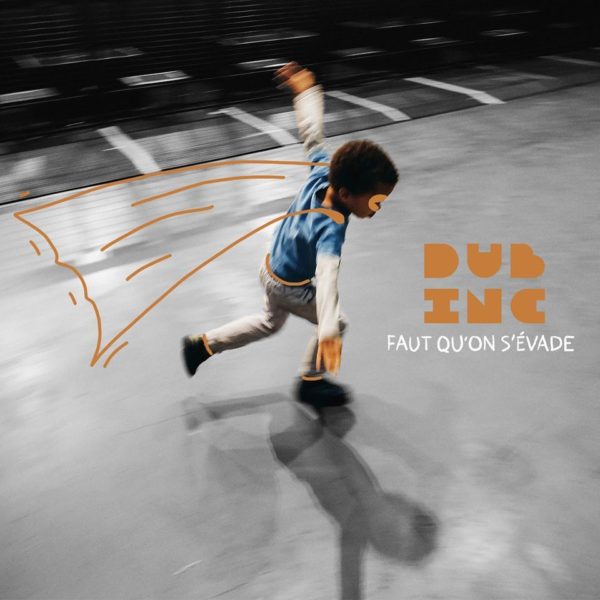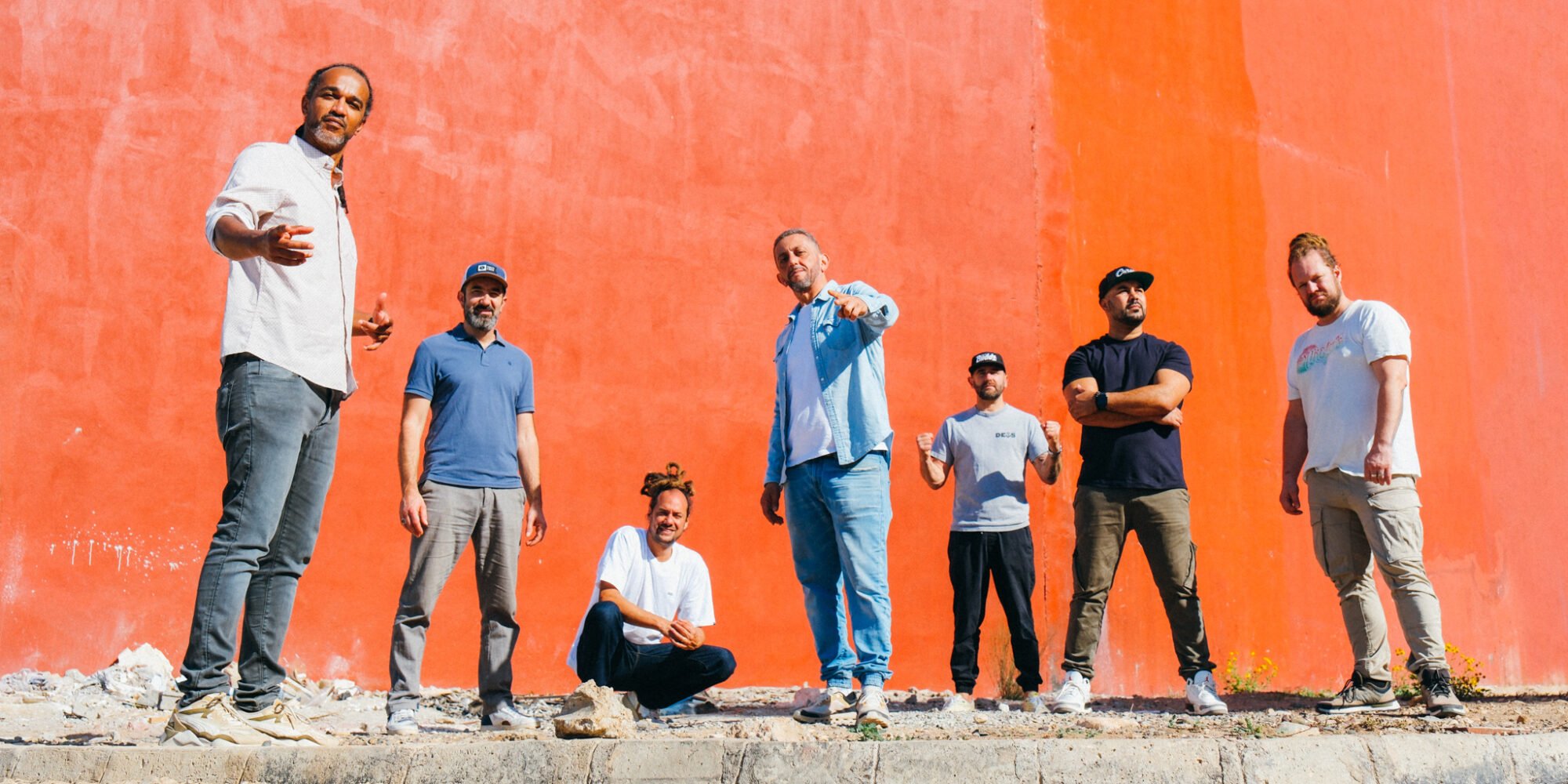
DUB INC Tackles Tough Times with a New Album, "Atlas"
Formed in 1998 in Saint-Etienne, France, the country’s industrial zone, DUB INC has championed a unique blend of reggae, Arabic music, rock, hip-hop, dancehall and more. Their high-octane live shows have earned them a fiercely loyal following in France, and far beyond. They’ve toured the world, including three U.S. visits. Their ninth album, Atlas, is out now, and expands their stylistic reach to include an irresistible cumbia track. Afropop’s Banning Eyre reached the band’s drummer, Grégory "Zigo" Mavridorakis, during the band’s 2026 tour to discuss the album, the band’s history, the challenges of touring in an immigration-mad world, AI and more. Here’s their conversation.
Banning Eyre: Zigo. How are you?
Zigo: Very well. How are you?
This is a great album. I really like it.
Thank you.
I've only seen you guys once at Drom in New York some years ago. It was a terrific show. I'm a fan. So you guys have been going over 20 years now and this is your ninth album. But let’s go back. Tell me how the band got started in the first place. What's the origin story?
You know, it's the typical high school band history, with absolutely no expectation except playing music and having fun. And it started in ‘98, so it's more than 25 years. But honestly, when we are in the tour bus, touring, I really feel the same energy as 25 years ago. You know, we are still high school guys having fun. Of course, we have families and other problems now, but I think the big chance we have is that we are still the same friends as we were 25 years ago.
That's wonderful. So where were you in high school?
We are all living in a small city, a small industrial city, more in the south of France, called Saint-Étienne. It's near Lyon. It's a medium sized city, but with the particularity of having a mix of people. We are multicultural. Our city was built with mines and factories. So a lot of people from outside of France came to work, like my grandparents, who came from Greece. So some came from North Africa, South Africa, Italy; and all of us are from different origins. Also in the band, we are from different social origins. Some are from very poor neighborhoods, and some like me from pretty high class, well-off ones. I think that's the DNA of the band. It’s that mix of culture and social background, all mixing together and trying to do something together.
I guess you've proven the concept by lasting all these years. That's great. Now the two main singers that I hear, one with the very clearly Algerian voice and the other more with a rougher sort of dancehall voice; tell me which is which.
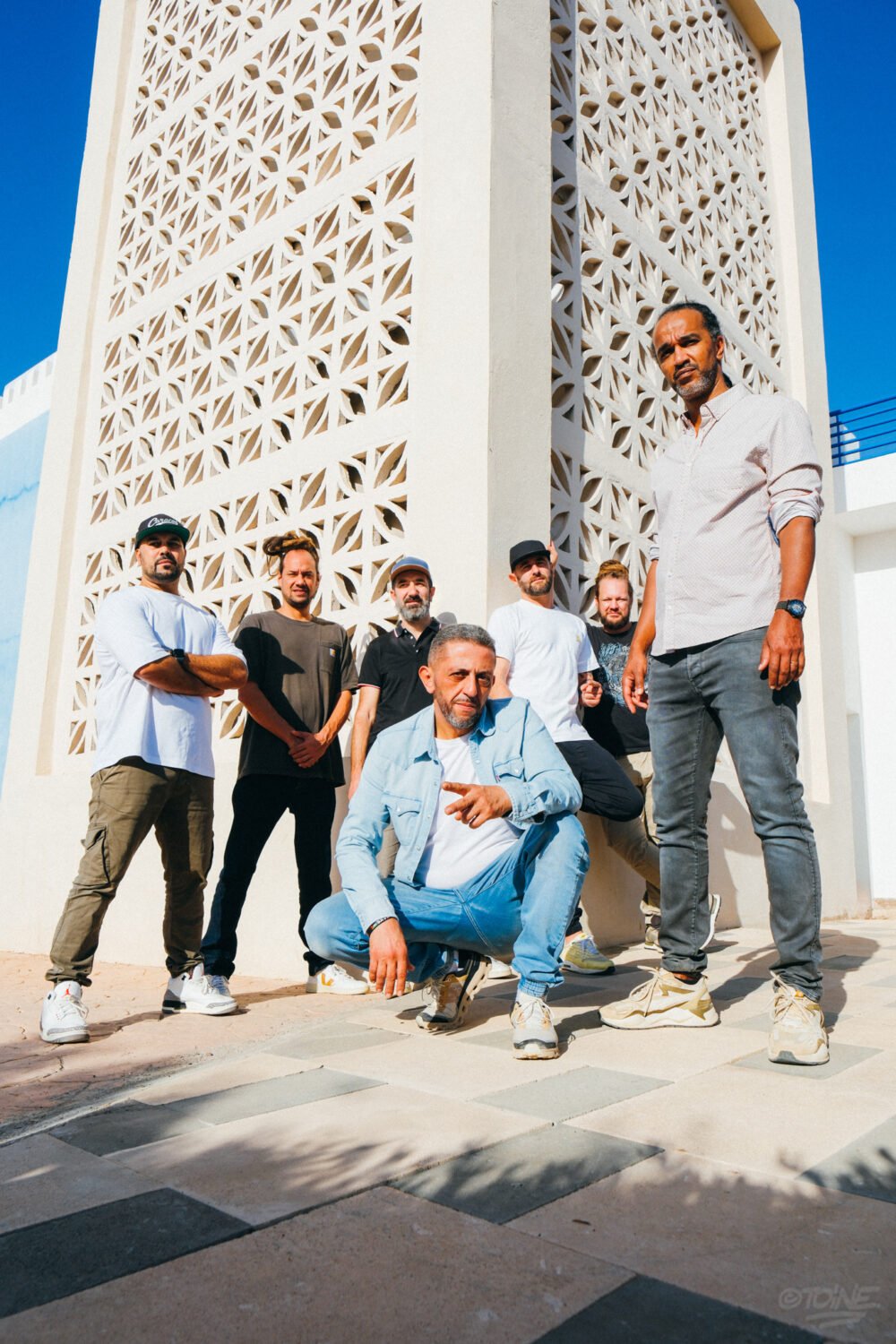
So Komlan (Aurelien "Komlan" Zohou), the one with the big voice, his father was from Benin, West Africa. And I would say his principal influence in the early 2000s would be Buju Banton. He tried to reproduce that kind of voice. And he's somebody who likes to write a lot about social topics. And then Hakim (Hakim "Bouchkour" Meridja), the other singer, his parents are from Algeria, as you said, from the part called Kabylie. They speak Kabylish language. It's not Arabic language, it's like patois called Kabylish. He’s definitely speaking half of the time with his family with this language. So it came very naturally for him to sing with this kind of oriental influences and this language too. And both of them, especially on the new album, tried to make more poetry than in the past.
We're going to talk about some of the songs in a minute. Hakim has a beautiful voice. You say he comes from Kabylie, so is he speaking Tamazight, or Arabic, or some mix of those?
It's kind of Tamazight, but it's different in Morocco and Algeria. It's different, but it's also very close.
The history Tamazight people in North Africa is fascinating, and complicated. So when you first started, what was what was the concept of the band? I think of the merger of reggae and kind of räi vocals as something I heard in some of Khaled's albums back in the ‘90s. I always thought, “Wow, that really works.” Was that a formula you were drawn to? What was the concept? Or did you have a concept?
Yeah, the very beginning of the band, we were just three, playing music, bass, guitar and drums. It was in 1997, and that's where the name DUB INC came, and it was a mix between dub music and metal music, only instrumental. So for one year it was like this, and then Hakim and Komlin, the two singers, came in the band, and so we switched immediately into a mix between reggae and Arabic music. The concept was reggae and Arabic music, but we always said that we have to put no limit in our music. We wanted to make it very open. We were very bad at copying, so even when we tried to copy Jamaican music, we never got it. There's a lot of Frenchmen that do really good Jamaican music, but not us, and I think it's a chance, because by doing this so badly, we didn't really copy something that people already heard, so it was a good thing.
That’s funny. I can relate to that. When I was younger, I played in a band that tried to play reggae and we also could not really get it either, but we came up with something of our own, you know? And yeah, that really shows in your music. I hear all those influences and yet it's very distinctive, unique. And this album is particularly strong. I really like the production, and the range of styles on the album.
I'm going to ask you about some of the songs, but one of the influences that I was really happy to hear is cumbia on that song, “Comment Faire.” I always think of cumbia and reggae as cousins, you know?
Yeah, we talked about it a long time before, but we never did it. Because we've toured a lot in South America, in Colombia, in Argentina, Mexico, we knew that someday we will do it, especially because one of our keyboard players plays accordion since he was a child.
Ah, that's where the accordion comes in.
That’s his main instrument, so we really wanted to go into this style, and finally, after nine albums we did it. And we are very happy because we've started touring and we play this song live and people really enjoy it.
So that's the first time you've used the accordion?
No, but for that style, yes. We had a lot of fun rehearsing in the studio. It's like it makes us smile, so it's great.
It says in the PR that this album grew out of “personal trials and a world in crisis.” I certainly know what you mean by a world in crisis. I mean, good God.
Yeah, it's such a crazy time.
But there were personal things too. What was the mood of the band when you were creating these songs?
When we started the album, we said we have to build some positive lyrics. We have to make people smile. But suddenly Ukraine was in a terrific war and Palestine was suffering from this terrible genocide. And in France also, as you probably know, there's a rise of fascism, which is absolutely unbelievable. And it’s probably because all the independent media has been bought by billionaires that are from fascism parts. So everything is turning totally into a new world for us since three years.
And so we said we want some positive lyrics, but at the same time we had to speak about all this shit happening. And so this album is not so positive. We have two or three songs where we try to make people smile. But yeah, I think we are kind of journalists ourselves. And we have to talk about what's happening in the world or what we see. We have the chance to travel a lot. So as Bob Marley said, we have to be the voice of the voiceless. So so yeah, we spoke about that. But at the same time, we try to speak more in poetry. We won't say Russia is bad with Ukraine or Israel is bad with Palestine. This would be how we would have written songs 20 years ago. But right now we try to play with words. And honestly, our audience already knows our point of view. So I think everybody understands the lyrics.
Yeah, I can certainly relate to that. It's a hard time to be positive these days. We're experiencing it over here, of course. It's a scary time. I don't know if you've heard this, but U2 just put out an excellent song called “American Obituary.”
Yeah, that's a good protest song.
I've been waiting for songs like that in the mainstream because our music is pretty apolitical these days.
But at the same time, as I told you, we have started a new tour now and what makes us get more positive right now is to see all these generations in front of us when we are playing concerts. I think because of media, we think that the only voice is the one of Trump, Macron, fascism, all of this. But I think the reality is different. And what we see in our concerts is that a lot of people feel concerned, feel ready to fight. I don't speak about violent fights, but to go in the street to protest. To resist, yeah. So right now, while we are on tour, I'm a bit more positive about all of this. And that's a good thing with music.
I'm sure that's very encouraging. Let's talk about some of the songs, starting with the title song, “Atlas,” which is a really strong opener, such a powerful song. What are you saying in that song?
Well, “Atlas” is a song about what we just said. It's about borders, and it says that if you go backward, look at the world in its global history, borders are just a concept. If you think about human beings, you can try to put borders where you want. But everything will change with time. You have to accept that people have to mix. And if you try to resist that, you will have wars. People have to mix, it's just a reality. It's a fact. So we just say you have to look at history and to accept the nature of human beings.
Of course. National borders are a relatively recent thing.
Nation is a concept. But humanity is humanity.
You know, most of our work is about Africa, dealing with cultural music, and we’re always running into situations where borders between countries are dividing groups that really belong together and have long histories together. You have to put national borders aside to understand what's really happening.
Yeah.
So tell me about the song “Drapeau,” meaning “flag,” and maybe it’s related. Musically, this is your band’s classic formula of Arabic music and reggae.
The song is about our two singers. In France, when you have a double nationality, you have two passports, and you always have to justify that you really love being French, you know? When you have two cultures, when your parents or grandparents come from another country, you can't choose. So in this song, Hakim says, “In the past, I was 100% Algerian and 100% French. Today, I am 100% Algerian and 100% French. And tomorrow, with my kids, it will be like this. I will be 100% Algerian and 100%. French. I'm not choosing. I'm not loving one more than the other.”
When you have two parents, you like your mother and you like your father. It's like this. And he says, “Don't ask me to justify. I'm French. I was born here. I love my friends. I love my family. And also, my parents come from another country. They couldn't go back now because their children, their grandchildren are here. So we are like this. And don't ask me to choose because I love being in Algeria and speak Arabic. And I love being in France. And I would give my life for both of the countries.” It's like this.
That's a great message.
But there’s something very specific in France. For me, I'm half-Greek and half-French. My wife is half-Spanish, half-French. We have two passports. Nobody asks us to justify. But when you're from Africa, everybody asks you to justify. When you are Muslim, everybody asks you if you love France or you prefer Africa. And that's, I think a specific problem in Europe, I don't know in the U.S., but in Europe, people are very scared about Africa.
That’s crazy, but I get it. So, how about the cumbia song “Coment Faire”?
It’s an unusual topic for us because it talks about when you break up in love. The guy says, “How could forget you? Even if we don't love each other, I don't want to forget the past. We made some great things.” That’s the best way to explain the song. Just keep on dancing and having fun. It's okay. Always.
Ok, so this is one of the lighter, more positive songs on the album. Well, that goes well with cumbia. Let’s talk about “Mémoires,” a pretty hardcore reggae number. I’m guessing the subject here is heavier.
Yeah, that's probably one of the deepest songs that we ever wrote. It's also the slowest song we ever wrote. It's a song with no chorus. We are featuring Marcus Gad from New Caledonia and each singer has his own verse. But it's all with the topic of colonization. And it says that our generation has the weight of our ancestors on our shoulders. Whether they are the one who colonized another country, or the one colonized by another country, our generation takes the weight of that. So at the end of the song, to conclude, Komlan asks our ancestors to give us strength to not make the same mistakes as they did in the past.
For our generation in France, if there are problems, for example, with the Algerian community and French community, it's because of the hate created by the colony 100 or 200 years ago. With the Black community and the French community, if there is hate right now, it's because during 500 years, French people came to Africa, took people on ships and brought them to America to work and be slaves. So of course, 500 years later, our generation has problems, and we just want to solve the problem and not recreate it again and again.
That’s powerful—how the weight of history stays with us. It’s obviously something that we deal with all the time in the U.S. with the history of African Americans and how they got here. Right now, we're in this moment when the powers that be want us to forget all that. But you can't. It's like you say. You inherit it. Like or not, it's just there, and you have to acknowledge it.
That’s exactly the problem with people like, for example, Marine Le Pen in France, or maybe Trump. It’s easy to solve a problem for the white people; it will be easier to forget it, but it's not the way it works. We want to look at the history and accept the history. This way, we can go forward and try to make things easier. I don't have the good words to say it in English.
No, you’re fine. I get your meaning. So now, let’s go from the slowest song to the fastest song, “Il le faut,” which has really got this urgent energy about it.
Well, “Il le faut” is actually a light song, with a light message. We wrote it because during maybe 10 years, we always end shows with the same song, a very energetic song. So we said we have to change this song, but we have to write it especially to close a show. So this was made to close our shows during tour. It’s a party song like we have to enjoy and make a party all together and move together and feel light together.
That's beautiful. Tell me about some of the collaborators you have. You mentioned Marcus Gad and you also have Grammy-winner Kabaka Pyramid. You like to collaborate, don't you?
I think but it's typical of the reggae scene. I think we all like to collaborate together. The thing is, just before the album, like two years ago, we bought a very big studio in our city. It was an old studio from 2000 and it was going to be sold to make a parking lot, so we said, “Don't do it!” because it's one of the biggest French studios. Honestly, it's 350 square meters, six meters high, a very, very nice studio, so we said, “Please don't sell it. We're gonna buy it.” So we bought it and rebuilt it like brand new, and we started the album there.
Kabaka Pyramid was on tour in Europe, and he was very close to our city so we proposed for him to come just to visit the studio, because we know that he loves to stay in the studio. He's a bit of a sound engineer. So it was more about to have his advice about the studio, and of course when you have a good feeling together and you are writing music it generally ends up in something. He didn't really have the time because he was on tour, so he said, “Let me finish the tour and I will come back.” So he came back for three days with us, chilling in the studio and making music all together.
We’ve been are very fond of his music since a of a long time before his Grammy, but it was just a pleasure to collaborate with him. I would do three albums with him because he's a very nice guy, very passionate about music. Even if I'm the drummer I can advise the singer while we are recording. “Maybe you could use that word or that note, change this, change that.” We are always 10 of us in the studio in the cabin working together and he enjoyed this way of working and and he was very open to give some advice. We had a real nice match all together. I would work with him with pleasure again.
Well, that's nice. I hope you get to.
He will come to play with us on tour soon, all of the big shows here.
So that raises this question. How do you write songs? Does one person write the song and then everybody kind of works on it or what's the typical way that you write songs?
Well, for this album, in our new studio we have five cabins. So all of us take one cabin or two in the same cabin, and we build some rhythms. We send the rhythms to the singers, and they try to write on it, to write lyrics. And then we all go in the big room of the studio, and we rehearse the song more and more and more, to find details, to make structures and stuff like this. And then the singers go together in a room, and they go deeper into the lyrics, the poetry. At this time, we go deeper into the music too. We try to rebuild again and again. We spend a lot of time in the studio. It takes one year for one album for us.
And at the end, we mix it all together. And we musicians, we propose some words sometimes when we think we could change some phrases.
So it's very collaborative here.
It's 100% collaborative, yeah. Well, the singers, they write most of the lyrics. But they're working with a beat that the musicians created together. And at the end, everybody has to be happy to release the song. We had some very good collaborations with the other artists too, but not everybody was happy, so we didn’t release it. We never release something that not everybody loves.
Well, that's a great process. I saw a mention of AI, artificial intelligence, in your in your promo, and it's obviously something that's confusing everybody right now, especially in the realm of art. What do you guys think about that, about the way that changing everybody's way of working?
If you ask me personally, who has no social media and stuff like this…
Ok. It’s not your area.
But in the progress of humanity, you have to select and you have to play carefully with it. I think with social media and AI, since 10 years, we are not careful enough. We use it too fast. And I think it's going to create a lot of problems very soon. That's my point of view. But at the same time, progress is sometimes good. So AI could be good and is probably good for a lot of things. So it's just a matter of how we're going to use it now. What I see with the music industry is that AI is breaking everything right now, because it's too easy to write a song in two minutes. Even a hit. We tried it just to check. I wrote a rhythm very quickly. We asked the AI to build a melody and a nice voice in that topic, in that style. In two minutes, it created really a hit. I was amazed at what it did with my music and the lyrics. Everything was perfect. I threw it immediately in the garbage. To me, it's really evil.
So this last week, two or three friends realized that what they were listening to was a fake artist created with AI. They were disappointed, and it's very sad. Me, I'm totally against this, but what can I do?
That's very interesting that you did that experiment. We have a friend who has compiled a list of what he calls “terrifyingly good AI world music.” My feeling about it is, like you say, there are things that it's useful for. I’m a writer and I use it for research, but I agree that it's moving ver fast, and people are too reckless. They can't really be trusted to use it in an ethical way. But on the other hand, you can't stop it. It's not going to go away. So I guess it's just something we have to deal with.
Human beings have created bombs. I wouldn't be against a little bomb for AI stuff and computer stuff and restart humanity some hundred years ago.
Uh huh. A reset.
Yeah, because I'm not sure we will go in a good way right now with it, but I can't control bombs so it won't be me.
Unfortunately, we don't get to make these decisions, but I hear you.
So you're on tour right now. You know, it's one of the things that really breaks my heart about the way things are here right now is it's becoming so hard for groups from abroad to tour here. How do you guys feel about touring in the U.S.?
We've been there the last three years. Honestly, from the bottom of my heart, it was three wonderful tours that I will never forget. We've toured around the world. We've made thousands of shows, but these three U.S. tours were really pure happiness for us. We really love American audience.
That’s good to hear.
We've met a lot of different people. We've toured with Mike Love, and honestly, his audience, people were so nice and so positive. We would tour for six months there if we could, but the reality of coming to U.S. with 12 people… First, we're not famous enough to make the good money, and politically, it's not easy for a French band to come to the U.S.. You have to be 12 people in different rooms at the same time at the embassy and say the same thing in the same way to be sure that we are not terrorists, especially with Arabic and Black guys. So it's too difficult right now. We would love to; we have a good contact to tour. We could tour a lot, but it became very complicated and very financially hard to go, at least in 2027. But we never know. I think all of us in the bond we want to come back to U.S.. So we just need to let the political thing go a bit.
Well, I sure hope things change, but I definitely understand and I want our readers and listeners to know how difficult it’s become under this regime.
I'm sure that things will change. We are linked with artists there. There's a lot of people who want to change the situation in USA. My brother lives in LA, so I know about the situation. And I know that things will change. I'm sure about this.
Well, there's so much resistance in the country now. Some things have to change, But it's just really unfortunate what's happened for foreign artists. So many of the African groups we love have made the same decision as you. It's just not worth it now. But we hope for change. We'll keep fighting for it. Anyway, Zigo, it's really great to talk with you and send our best to the band.
Okay, thanks very much. Peace.

Related Audio Programs
The Story of Rai